
There’s a moment most parents know well. You’re standing in your kid’s room at 9 p.m., staring at a mattress on the floor, a dresser missing two drawer pulls, and roughly forty-seven stuffed animals with nowhere to live. You open your laptop, type something like “kids bedroom furniture sets,” and immediately find yourself drowning in options that all look identical, all claim to be “durable and safe,” and all have review sections full of people arguing about whether the screws strip after six months.
Here’s the thing: buying kids’ bedroom furniture is genuinely more complicated than buying adult furniture. You’re selecting for safety certifications, sizing that accounts for a child who will grow eight inches in three years, materials that survive a combination of juice spills and amateur gymnastics, and storage that actually functions in a room the size of a walk-in closet. This guide walks through all of it. If you’re in the Wichita area, Crazy Jay’s Furniture & Sleep Shop is worth a visit before you click “add to cart” on anything; some of this you really need to see in person.
Start with safety: what the certifications actually mean
ASTM certifications parents should actually recognize
When a product listing says “safety tested,” that phrase means approximately nothing without a specific standard attached to it. The two certifications worth knowing for children’s beds are ASTM F1821, which governs toddler beds and is incorporated into a mandatory CPSC rule, and ASTM F1427, which covers bunk beds and loft beds. As of August 29, 2026, the toddler bed standard officially updates to ASTM F1821-26, though the CPSC has confirmed the changes are editorial rather than substantive, so the structural requirements stay the same.
Two other signals worth checking: the JPMA certification mark, which indicates a product was tested by a third party against relevant ASTM requirements (it’s not the law, but it’s a meaningful signal), and the CPC, or Children’s Product Certificate, which U.S. manufacturers and importers are legally required to issue for regulated children’s products. If a listing names a specific standard, that’s a good sign. If the only claim is “meets all safety requirements,” dig deeper before buying.
Physical safety features to check in person
Certifications tell you a product was designed to meet certain standards. They don’t tell you whether the guardrail on that bunk bed feels solid or rattles when you push on it. For bunk beds, check that guardrails are secure on all sides, not just the wall-facing side. For dressers, anti-tip anchor kits should be included; the CPSC has long recommended anchoring freestanding furniture to walls to prevent tip-over injuries, and a dresser falling on a child is a serious hazard. Look for rounded corners on nightstands and bed frames, no sharp hardware that catches clothing or fingers, and slat systems that don’t flex dramatically when weight is applied. These are things photographs cannot communicate. You need to actually be there.
Sizing kids’ bedroom furniture to the actual child
From crib to twin: the toddler and preschool years
A standard crib and toddler mattress runs about 27 to 28 inches by 51 to 52 inches, and it typically serves kids from around 18 months to age five. The toddler bed frame that uses that same mattress is a legitimate option, but here’s where the math gets interesting: if you buy a twin bed at age three instead of a toddler bed, you skip an entire transition purchase. A twin mattress is 38 by 75 inches, which a three-year-old will not fill, but they’ll grow into it within a year or two and stay in it through elementary school. Sizing up for the next three to five years rather than buying for right now is almost always the smarter financial move, one purchase instead of two, with no meaningful downside for the child.
Twin XL, full, and beyond: school-age through teen
Twin XL adds five inches of length over a standard twin, landing at 38 by 80 inches, which makes a real difference for kids over five feet tall. For most school-age children, a twin or twin XL is the right call; for teens who want more sleeping width, a full at 54 by 75 inches makes more sense than going straight to a queen. The principle holds throughout: size for who the child will be in three to five years, not who they are today. Children’s bedroom furniture that transitions from elementary school to middle school to high school without a full replacement is the goal, and it’s achievable if you think about sizing at the point of purchase rather than after the fact.
Kids’ bedroom furniture: materials that survive daily use
Why wood species and construction method matter more than the finish
Solid hardwoods, specifically oak, maple, and beech, hold up best under the kind of wear kids deliver. That wear is less about single dramatic events and more about relentless low-level abuse over years: drawer corners banged repeatedly, bed frames kicked in passing, surfaces used as impromptu workbenches. Hardwoods resist dents, grip screws better as the furniture ages, and can be refinished rather than replaced. High-grade plywood with sealed edges is a reasonable budget-tier alternative; particle board and MDF are not. They absorb moisture, swell at the joints, and begin failing within a few years in a high-use environment.
One labeling note worth understanding: a listing that says “wood” does not mean solid wood. “Wood” can legally describe a product that is mostly particle board with a wood veneer surface. “Solid wood” is the term you want, and even then, checking the specific species matters because pine and poplar are softer than oak or maple and will dent under normal use.
Finishes and surfaces worth cleaning without regret
Water-based, low-VOC finishes sealed with polyurethane or a catalyzed topcoat are the practical standard for kids’ bedroom furniture. They resist spills, wipe down with a damp cloth, and don’t require any kind of strategy when something gets on them. Natural wax and oil finishes look genuinely beautiful in photos and showrooms, but they require periodic re-application, and they stain. In a room where juice boxes, markers, and face paint are in regular rotation, that’s not a trade-off worth making. For any upholstered pieces, a reading chair, a padded headboard, polyester blends, microfiber, and performance vinyl are the right call. They wipe clean instead of requiring a stain removal tutorial.
Storage that keeps up with how fast kids accumulate stuff
Beds that do more than just hold a sleeping child
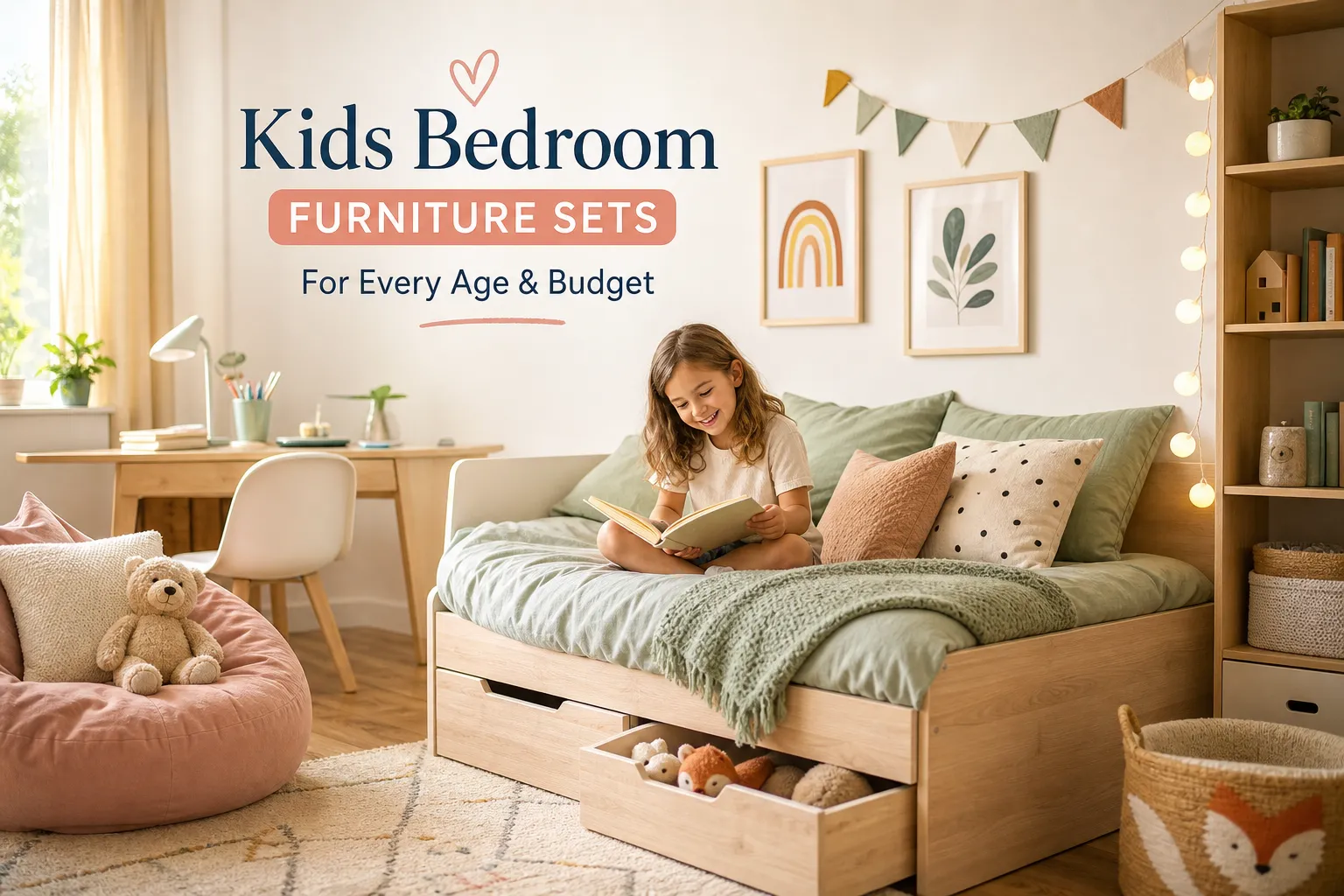
The reason loft beds, bunk beds, and platform beds with integrated drawers show up in nearly every discussion of kids’ bedroom storage solutions is straightforward: they convert one room footprint into two or three functional zones. A loft bed turns the space underneath into a desk area, a reading nook, or a play space. Under-bed drawers on a standard twin frame can replace an entire dresser in a small room, which matters when a room is ten by ten feet and needs to hold a bed, a desk, and somewhere for clothes. Storage-integrated beds from kids’ furniture sets often cost less than buying the bed and storage separately, though the savings vary by brand and configuration, so it’s worth comparing both options at your budget level.
Dressers, shelving, and the case for vertical space
Floor space in kids’ rooms is almost always limited. Vertical space is almost always underused. A tall five-drawer dresser holds more than a wide three-drawer one while taking up less floor area. Floating shelves mounted at child height create display and book storage without any floor footprint at all. Cube organizers with fabric bins give toys a defined home and are easy enough for kids to actually use during cleanup. The planning principle that saves the most frustration: figure out where everything is going to live before you decide which furniture to buy, not after the dresser is already in the room and blocking the closet.
What your budget actually gets you at every price point
Under $300: toddler and budget twin sets
In the $100 to $300 range, you’re primarily looking at toddler room-in-a-box sets from brands like Delta Children, which typically bundle a toddler bed with a toy box and a small table and chair set. Basic twin bed frames and standalone dressers also start in this range. The construction at this price point is usually adequate for a few years, but joinery and drawer hardware are where things tend to fail first. If you’re shopping here, pull the drawers in and out at the store and check that the joints don’t flex.
$300 to $900: the midrange sweet spot
This is where most families find the practical center of gravity: a complete twin bedroom set with dresser and nightstand that holds up through elementary and middle school without requiring replacement. Sets from established brands like Storkcraft and Harper & Bright land in this range, and matching pieces are available. The price-per-year math usually favors spending here rather than replacing budget furniture twice. This is also the range where flexible financing through a local retailer starts to make real sense for families managing a tight monthly budget, since breaking a $600 set into manageable payments changes the math considerably.
$900 and up: premium sets built to last into the teen years
At this price tier, you’re getting solid hardwood construction, longer warranties, and pieces that genuinely look at home in a teenager’s room rather than a toddler’s. Premium kids bedroom furniture at this level, from specialty collections at higher-end retailers, is where the “buy once” logic becomes realistic. Note that price-band definitions shift across sources; some retailers mark the premium tier at $800, others at $1,500 or above, so treat the $900 threshold as a rough guide rather than a fixed rule. If the goal is to purchase a bedroom set at age six and not revisit the question until college, this tier is where that becomes achievable. The premium is real, but so is the math of buying a $400 set twice instead of an $800 set once.
Why seeing the furniture before you buy it makes a real difference
The problem with picking kids’ furniture entirely from product photos
A dresser that looks solid and well-built in product photography can wobble noticeably when you open the drawers in person. Drawer glides that appear identical across listings vary dramatically in actual feel and durability. A finish photographed as warm white can look stark and plastic-like under a bedroom’s ceiling light. Online shopping works well for accessories and decor, but for the primary structural pieces in a child’s room, buying from a photo carries real risk. The certifications, the construction quality, the actual weight of the frame: none of those things translate reliably through a screen.
What a local in-stock selection actually gives you
At Crazy Jay’s Furniture & Sleep Shop in Wichita, parents can walk the floor and physically evaluate children’s bedroom furniture before making a decision. Open the drawers. Check the frame weight. See the finish under actual lighting conditions. Because you’re working with in-stock inventory, you know exactly what you’re getting before it comes home; no waiting on a shipment to discover the color is wrong or the drawer hardware feels flimsy. For families in the Wichita area looking for kids’ bed frames and dressers across a range of budget levels, it’s a straightforward way to take the guesswork out of a purchase that genuinely benefits from getting it right the first time.
The framework that makes this decision manageable
Choosing bedroom furniture for children gets much simpler with a clear order of operations. Start with safety certifications that name a specific standard. Size for the child they’ll be in three to five years, not the child they are today. Choose materials that clean without drama and construction that holds up to actual daily use. Build storage into the bed, or the plan before the room is full. Then match the budget to how long you need the furniture to last, not just what’s available at the lowest price point right now.
The right set isn’t the most expensive option or the one that photographs best on a product page. It’s the one that fits the room, fits the child, survives the next several years intact, and doesn’t send you back to square one in eighteen months. Buying good bedroom furniture for kids is a decision worth making once, and it’s worth making in person.
If you’re in Wichita or the surrounding area, Crazy Jay’s Furniture & Sleep Shop is a solid place to start. Walk into our East or West location, ask the team your questions, and leave with something you’ve actually touched and tested. For a purchase this size, that hands-on process beats midnight comparison shopping every time.