
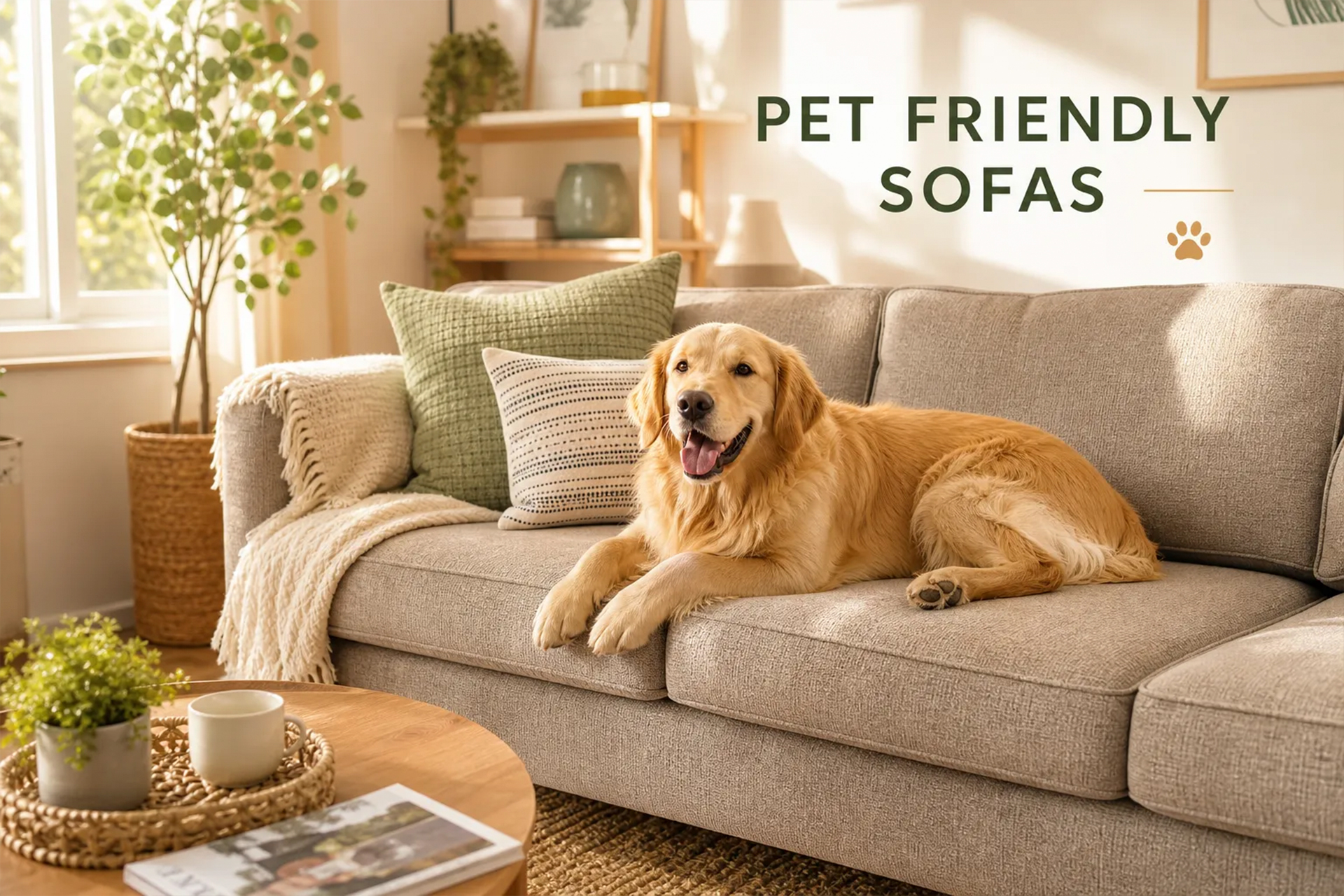
There’s a specific moment most pet owners can pinpoint. It happens somewhere between bringing the sofa home and watching their dog do that slow, deliberate circle-and-flop routine directly onto the armrest. The fabric snags. The cushion compresses. A faint smell of wet fur permanently takes up residence. And it’s only then that the realization hits: they bought the wrong sofa.
Choosing a pet friendly sofa when you share your home with animals is genuinely complicated. You’re solving four problems at once. Hair embeds itself into every fiber like it’s building a nest. Claws treat upholstery as a dedicated scratching surface. Accidents need to be cleaned out completely, or the odor stays forever. And then there’s the simple physics of a 90-pound dog launching himself onto the same corner every single night. Most people solve this by buying whatever looks good in the store and hoping for the best. This article is the alternative to that approach.
One genuinely useful move for Wichita-area pet owners is stopping by Crazy Jay’s Furniture & Sleep Shop before buying anything online. Feeling the difference between a tight performance weave and a loose linen blend in person tells you more in 30 seconds than a product photo ever will.
Pet Friendly Sofa Fabrics That Actually Survive Pets (and Which Ones Fail Fast)
Fabric choice is where most pet friendly sofa decisions are won or lost. The answer isn’t one-size-fits-all, because not all pets create the same problem. A heavy-shedding Golden Retriever is a completely different challenge than a scratch-happy cat, and the fabric that handles one beautifully might be a disaster with the other.
Performance fabric and Crypton: the strongest all-around choice
Performance fabric is a tightly woven synthetic textile, usually polyester-based, engineered to resist staining, moisture, and wear rather than just look attractive. Crypton takes that concept further by integrating a stain and moisture barrier directly into the fiber structure during manufacturing, rather than applying a topical spray that wears off over time. The practical result is a fabric where liquids bead near the surface, odor-causing bacteria have a harder time taking hold, and the tight weave physically resists claw penetration better than most alternatives. For pet owners prioritizing scratch-resistant sofa options, performance fabric is the place to start.
For households dealing with stains and odors, Crypton is the clear leader. It combines a moisture barrier, stain-release properties, and antimicrobial treatment in one engineered system. Standard performance fabrics do similar work, though without the permanently bonded protection layer that makes Crypton worth seeking out when accidents are a real concern.
Microfiber and leather: reliable options with clear tradeoffs
Microfiber is excellent at releasing pet hair because its smooth, tight surface keeps strands from embedding deeply. It also handles scratches reasonably well. The weakness is odor: microfiber is more absorbent than performance fabric, which means accidents that aren’t cleaned thoroughly tend to linger. If you have a heavy shedder but accidents don’t happen often, microfiber is a strong choice.
Leather sits in a genuinely complicated position. Pet hair wipes right off, which is a real advantage for heavy shedders, and cleaning up spills is fast. The problem is permanence: claw marks on leather don’t fade or blend in over time. They accumulate. For dog households where scratching isn’t a major issue, leather can be a durable long-term option. For cat households, it’s usually the wrong call regardless of how good it looks in the showroom.
What to skip: the fabrics that look great until they don’t
Velvet, open bouclé, loosely woven linen, and delicate twill share a common problem: they’re beautiful in a showroom and struggle in a pet home. Loose weaves give claws something to catch. Pile fabrics trap odors even after surface cleaning. Most of these materials can’t be cleaned aggressively enough to handle accidents without water spotting or texture damage. The regret cycle with these pet-unfriendly fabrics is remarkably consistent: stunning in the store, rough after six months with a dog.
How to Choose a Pet Friendly Sofa: Construction Details That Decide Longevity
Most shoppers spend 90% of their decision energy on fabric and almost none of it on what’s underneath. That’s backwards. The construction beneath the upholstery is where long-term durability is actually determined, and under pet use, the gap between a well-built frame and a budget one becomes obvious faster than it would in a pet-free home.
Frame quality and why it matters more with pets
Kiln-dried hardwood is the consistent benchmark for sofa frames in heavy-use households. The drying process removes moisture from the wood, which reduces warping, cracking, and joint loosening over time. Under the repeated stress of large dogs jumping on and off the same spots, a cheap frame softens and sags in ways that become structurally problematic within a couple of years. A kiln-dried hardwood frame with reinforced joinery at the stress points is the single most important construction feature for pet households with large or heavy dogs.
On the fabric side, rub count is the industry metric for abrasion resistance. Heavy residential use requires a minimum of 30,000 to 40,000 double rubs, and 50,000 or above is a safer target for pet households. Commercial-grade fabrics reach 100,000 or more. Rub count isn’t a perfect proxy for real-world claw resistance, but it’s the most reliable indicator of how long a fabric will hold up to daily friction and use.
Cushion fill and the long game
Cushion compression accelerates under pet use. A dog who claims the same corner of the sofa every night creates localized compression that loose-fill cushions handle poorly. High-density foam, or foam-and-fiber blends, maintains shape significantly longer than overstuffed options. A pet-safe furniture investment can still feel worn out within a few years if the cushion fill was the weakest part of the package, even with great fabric and a solid frame.
The Features That Turn a Regular Sofa into a Pet-Proof Sectional or Couch
Beyond fabric and frame, certain design decisions create a meaningful practical difference in pet households. These aren’t marketing features, they’re structural choices that affect how easy the sofa is to live with over time.
Removable, washable covers: the single most useful feature
A sofa with machine-washable covers or removable cushion cases can be cleaned thoroughly, not just spot-treated. The difference between deep cleaning and surface cleaning matters enormously when you’re dealing with pet hair, dander, and the occasional accident. The ability to pull covers off, run them through a wash cycle, and put them back extends the useful life of the sofa in ways that no spray or topical treatment fully replicates. This is one of the most underrated features on any pet-friendly sofa fabrics checklist.
Modular construction and why pet owners benefit most
Modular sofas are worth taking seriously if you have multiple pets or particularly destructive animals. When one section takes the brunt of the damage, you replace that section rather than the entire sofa. For households with large dogs or cats who have claimed specific spots as their own, this is a practical cost-saving feature built into the design rather than an afterthought. A pet-proof sectional built on modular bones is often the smartest long-term purchase in this category.
Arm style and cushion configuration details that reduce fur buildup
Tight, flat arms collect dramatically less fur than pillow-top arms. Pillow tops have seams, crevices, and soft surfaces where hair settles and stays. Minimal tufting on cushions serves the same purpose: every button and tuft is a collection point for debris that requires extra effort to clean out. These design choices don’t always get attention in buying guides, but they affect weekly maintenance time in a real and measurable way.
How to Clean Pet Hair, Stains, and Accidents Without Ruining Your Sofa
Even the most durable pet-resistant upholstery requires the right cleaning approach. Using the wrong method on the wrong fabric causes damage that compounds over time. Well-meaning pet owners watermark their cushions or strip protective treatments regularly because they skipped one step.
Reading the care code before you touch anything
Every sofa ships with a care tag that tells you exactly what cleaning methods are safe. W means water-based cleaner is safe; S means solvent-only; W-S means either works; X means vacuum and brush only, no liquid. Ignoring this tag is how a minor accident becomes a permanent stain or a visible water ring. Read it first, every time, even if you’ve cleaned the sofa before.
Removing pet hair the right way by fabric type
Vacuum first, always. Work slowly along seams and under cushion edges, where embedded hair accumulates most. Follow with a rubber glove or rubber brush for strands the vacuum doesn’t fully lift. On microfiber, a slightly damp microfiber cloth can help finish the job. On leather, stick to dry tools and a soft cloth. The lint-roller-only approach that most pet owners default to misses the embedded fibers entirely and only handles surface-level hair.
Tackling urine and stains without spreading the damage
Act immediately: blot with white towels and do not rub under any circumstances. Rubbing drives the liquid deeper into the cushion and spreads the affected area.
Once you’ve blotted, apply an enzyme cleaner, Bissell Professional Pet Stain and Odor Removing Formula, Rocco & Roxie, and Biokleen Bac-Out all break down urine compounds at the molecular level rather than just masking the smell. Let the enzyme cleaner dwell according to the label directions, then blot again. Vinegar-and-water works as a follow-up only on fabrics with a W care code that can safely handle mild acidity.
The Warranty Trap Most Pet Owners Fall Into Before They Buy
This part of the buying process gets ignored until something goes wrong, and by then it’s too late to make a different choice. Understanding what your warranty actually covers before you sign anything saves a frustrating conversation later.
What a standard manufacturer warranty actually covers
Standard manufacturer warranties cover defects in the product itself: frame failures, stitching separation, spring issues, workmanship problems. They almost universally exclude pet-related damage. Scratches, claw marks, chewing, staining from accidents, and general wear from animal use are consistently denied under basic warranties across major brands. This isn’t fine print buried in a document, it’s the default across the industry.
Protection plans and what to look for before signing
Some brands offer separate pet protection plans as an add-on, and coverage varies considerably. Some plans cover only bodily fluid stains. Others cover scratches and chewing up to a claim limit. Some cap the total number of claims per year. The practical rule is to read the protection plan’s pet damage language specifically before assuming anything is covered. “Accidental damage” in the plan description does not automatically mean claw marks are included. Verify the exact exclusions before you buy, not after.
Putting It All Together: Buy a Pet Friendly Sofa Smarter, Live Better With Your Pets
The framework for choosing the right pet friendly sofa comes down to matching fabric to your pet’s primary challenge. Heavy shedders need tight, smooth surfaces like performance fabric or microfiber that don’t trap hair. Active scratchers need tightly woven synthetics or performance fabric rather than leather, which shows claw marks permanently. Accident-prone pets need Crypton or a similar integrated moisture-barrier system that goes beyond surface-level stain resistance. Construction quality determines how long even the right fabric holds up, and a solid cleaning protocol keeps the sofa in good condition between replacements.
The worst buying mistake in this category is choosing based on appearance alone without considering how the specific fabric and frame will hold up against your specific pet. A sofa that looks incredible in a catalog photo and falls apart in eight months isn’t a bargain at any price point.
If you’re in Wichita and want to make a confident decision, stop by Crazy Jay’s Furniture & Sleep Shop at either the East or West Wichita location. The sales team there doesn’t work on commission, which means no pressure toward a higher price point. You can feel the pet-friendly sofa fabrics in person, ask honest questions about what holds up best in pet households, and compare options side by side rather than guessing from a screen. Everything covered in this guide becomes much easier to apply once you can physically touch the fabrics and sit on the frames you’re considering. That’s where the research ends and the right decision starts.